


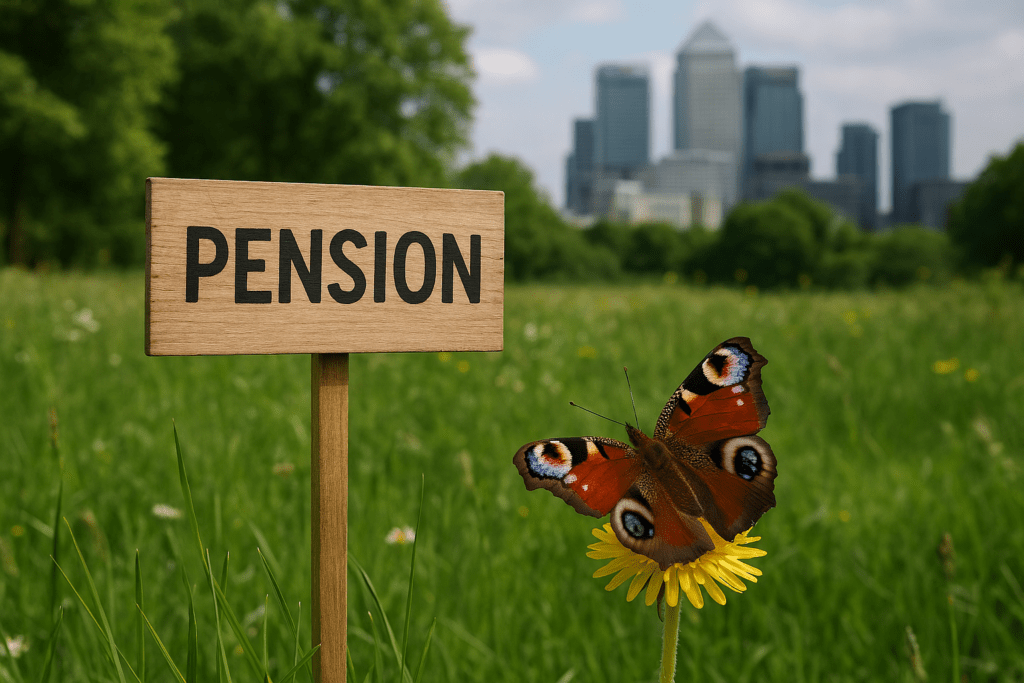
Nature-based risks and opportunities are starting to find their way onto more pension scheme trustee meeting agendas and into scheme investment strategies. To explore what this means in practice, Jason Coates recently sat down with a panel of industry experts.

Our panel included Bobby Riddaway (Managing Director of HS Trustees and Founder and Chair of the Trustee Sustainability Working Group), Mark Thompson (Executive Chair of the UBS Pension & Life Assurance Scheme Investment Committee), and Ben Stansfield (Partner and Head of Sustainability at Gowling WLG), each bringing unique perspectives on sustainability and investment.
Here are five key things we learned from their thought-provoking discussion.
Nature is everywhere and affects everything
When we talk about nature-based risks and opportunities, we’re talking about a type of sustainable investing. The pensions industry has successfully navigated sustainable investing around climate change for many years. While nature and climate are closely linked, nature-based investing is still new territory for many pension schemes.
The impact on nature of an investment choice is important. But, nature also creates a discrete asset class to be invested in of its own, such as companies focused on conservation, restoration, credits, or habitat banks that help developers meet biodiversity net gain obligations (explained below).
Nature isn’t just an asset class; it’s much broader. Nature is about everything from food and water supply to flood defences, and forestry, and because of this broad reach, nature can impact all investments. For example, issues with water scarcity or quality could impact returns on equity in a beverage production company (incidentally, at the time if writing this blog post, thousands of homes and businesses in Kent and East Sussex had been without drinkable water for five days). So, it’s important for pension scheme trustees to understand both the potential impact of nature on existing investments and the new opportunities it presents. It is a stewardship issue and an investment choice issue.
Getting started is the most important thing right now
We asked the panellists what advice they would give to trustees new to nature-based risks and opportunities.
Mark Thompson’s main message for trustees who aren’t sure how to approach the issue was one of action without seeking perfection. As a first step, he suggested seeking training from investment advisors to build understanding of nature’s impact on investments, then discussing next steps.
The next steps will depend on the size and nature of a scheme. Trustees of a closed defined benefit scheme on the journey to buy-out, for instance, might decide to only understand and monitor the impact on current investments or consider the view on nature of potential insurance counterparties. In contrast, trustees of a large schemes might choose to make a change to their investments and adjust their stewardship agenda to give nature a degree of priority. Whatever actions trustees take, Mark’s view was that they should act proactively and do it sooner rather than later; trustees do not need to wait for future legislation or regulatory guidance telling them to act.
Bobby Riddaway urged small and medium schemes not to brush the issue under the carpet because of a lack of appropriate investment options. Nature is an issue for all schemes and, whilst larger schemes do have more accessible investment opportunities in the nature space at the moment, as demand increases it will become easier for smaller schemes to invest in nature-based assets. In the meantime, nature will continue to pose a systematic risk to all investments and so at the very least, trustees of smaller schemes should begin to understand these issues now and engage with their investment consultants and fund managers.
Ben Stansfield spoke about his experience advising entities in many sectors on nature impact and working with the nature industry itself. It’s a highly collaborative area and his top tip for trustees grappling with nature issues is to reach out to people in the wider business and environmental communities with relevant experience. Everyone will need to get to grips with nature eventually, and those already entrenched in it are eager to share their learnings and mistakes.
Nature should be integral to an investment strategy
Our panel agreed that nature should be integral to trustees’ overall investment strategies. Trustees can integrate nature in a number of ways, such as including it in their Implementation Statement as a stewardship priority. Taking actions like this will help bring nature to the forefront and integrate it into normal trustee business.
Responsibility doesn’t just fall at the feet of trustees though. There is a need for the pensions industry at large to work together to move away from the idea of nature as a thematic or novel investment to an investment that is fundamental to the UK economy and one that should form part of schemes’ overall portfolios. Trustees can help drive that by encouraging their investment advisers to get involved in industry initiatives designed to help drive the development of nature-based investments for all schemes, to make nature-based investing more accessible.
For the largest schemes, there is a real opportunity to lead and make a difference. The scale to make direct investment and to hold businesses to account on nature impact is a responsibility to live up to.
Nature is high on the Government’s agenda (and so is UK growth)
In the Environmental Improvement Plan 2023, the Sunak Conservative Government set out its goal of reaching £1billion of private investment in nature by 2030. The Environmental Improvement Plan 2025 was published on the eve of our panel discussion. In it, the current Government has pledged to continue to prioritise nature, through initiatives that will create jobs (and therefore pension scheme members) and investment opportunities.
The Government is already using legislation to further the nature agenda, something Ben Stansfield comes across frequently in his practice through biodiversity net gain (BNG). BNG is mandatory in England and requires developers to assess a development site, assign to it a net biodiversity score, and then increase that score by 10%. It has led to the development of a new industry, that of habitat banks. Some developers increase their score by including nature improvements on site, but that is not always practical. Instead, some developers purchase units in a habitat bank – areas of high biodiversity specifically created for this purpose – to meet their obligations.
In 2026, BNG will become mandatory for Nationally Significant Infrastructure Projects (NSIPS). Given that the Government plans to fast-track 150 planning decisions for major infrastructure projects this parliament, it seems there will be significant scope for nature restoration through the extension of BNG to NSIPS. This is a clear, relevant nature-related aspect for our large pension schemes to consider when investing.
You might ask “what relevance does this have to pensions”? The Government wants to see our large pension schemes investing more in UK growth assets like infrastructure. It is encouraging investment in these sorts of assets through things like the Mansion House Accord, and powers to mandate how scheme assets are invested in the Pension Schemes Bill. Under the Bill’s provisions, if the country’s largest multi-employer workplace pension schemes do not invest in UK growth assets voluntarily, once the Bill becomes law, the Government will have the power to pass legislation requiring them to. So, pension schemes will need accessible investments which align with the Government’s agenda.
These developments, and others, suggest that there will be more, and more accessible, opportunities for large pension schemes to invest in national projects with a positive nature impact soon, at a time when pressure to do so is increasing. Even now, trustees of these schemes can make choices on where and how they invest. They can influence the impact on nature. They can start to invest in nature as an asset.
There are some challenges, but we should remain optimistic
Anything new presents a challenge. In the world of pension scheme investments, the nature of trustee duties often makes those challenges particularly acute. The investment strategy adopted by trustees must be in pursuit of members’ best financial interests, and competing interests like climate change and nature can sometimes appear to be difficult to balance with that duty. On the other hand, the fiduciary duty is flexible, especially for large scheme with long-term horizons, and we may yet see statutory changes to that duty that give trustees greater confidence to invest sustainably for wider good.
Unlike other types of sustainable investment though, nature is tangible, and most people understand its importance. Investing in nature might therefore be easier for trustees to understand, explain to members, and incorporate into their investment strategy.
The amount of information available to trustees is ever increasing. For example, the Environmental Improvement Plan 2025 is a roadmap for trustees, setting out where investment will be needed and where growth can be expected. We also expect the Pensions Regulator and the various pensions professional bodies to provide useful guidance in the future.
Unfortunately, the present reality, at least for smaller schemes, is that appropriate investment opportunities aren’t readily available and that needs to change. The industry will need to influence policy makers into establishing a framework in which nature investing can thrive. The larger schemes, who are starting to focus on nature, can lead the way, influence change and offer support to smaller schemes.
Trustees do not have to wait for that framework to develop around them though. There are steps trustees can take now like:
- asking their investment advisors for training;
- asking their fund managers about their approach to nature;
- asking their legal advisers about legislative developments that might impact their existing investments; and
- staying up to date with developments in this area.
Our panel all agreed that things are moving in the right direction, albeit slowly at times. When asked where they thought we would be in 10 years’ time, they agreed that nature-based investments will be commonplace for pension schemes and nature will be much more firmly embedded at the centre of investment strategies.
To hear more from our panel and find out more about this topic you can watch the webinar in the embedded player above or click here for the webinar’s webpage.
Jason Coates


Jason Coates is a leading UK pensions lawyer. He helps his clients to respond to the challenges and opportunities they face in operating their pension arrangements, commercially and without jargon.