



On 9 March 2026, the UK Government set out its Fraud Strategy for 2026 – 2029. As the strategy identifies, fraud is consistently the largest reported crime in England & Wales, representing 45% of reported crime and affecting millions of innocent individuals and businesses each year. The new strategy aims to address the scale and sophistication of modern fraud with a new and accelerated response.
The new strategy is informed by two further reports, also published yesterday.
Economic and social cost of fraud
The first report, Economic and Social Cost of Fraud 2023 – 2024, estimates the total economic and social cost of fraud against individuals and businesses in the year ending March 2024 to be £14.4 billion. This figure includes costs in anticipation of fraud (i.e. costs incurred in an effort to prevent fraud); costs as a consequence of fraud; and costs in response to fraud (including the costs of investigating, enforcement and operating legal and other institutions in response to fraud). The report notes though that even this significant sum is a conservative estimate, given the difficulty of detecting fraud.
Scale, nature and evolution of fraud
The second report, National Assessment Centre Fraud assessment 2025, surveys the modern fraud landscape to identify the scale, nature and evolution of the current fraud threat. It identifies that modern fraud threat is typically overseas, online and tech-enabled, and it is on the rise – with both individuals and organised crime groups bring drawn to fraud as a low-risk, high-reward activity. The UK’s routine dependence on online and social media platforms, and a series of major data breaches in recent history, provide opportunities for criminals to target victims. Further, the report notes criminals’ ability to react and adapt quickly to counteract control measures, and anticipates greater use of Generative AI to enhance the sophistication of attacks, for instance by using deepfakes, voice-cloning and large language models to make phishing attacks more convincing.
The Strategy – Disrupt, Safeguard, Respond
Against this backdrop, the Home Office has set out its Fraud Strategy 2026 – 2029, built on three pillars of activity – Disrupt, Safeguard and Respond.

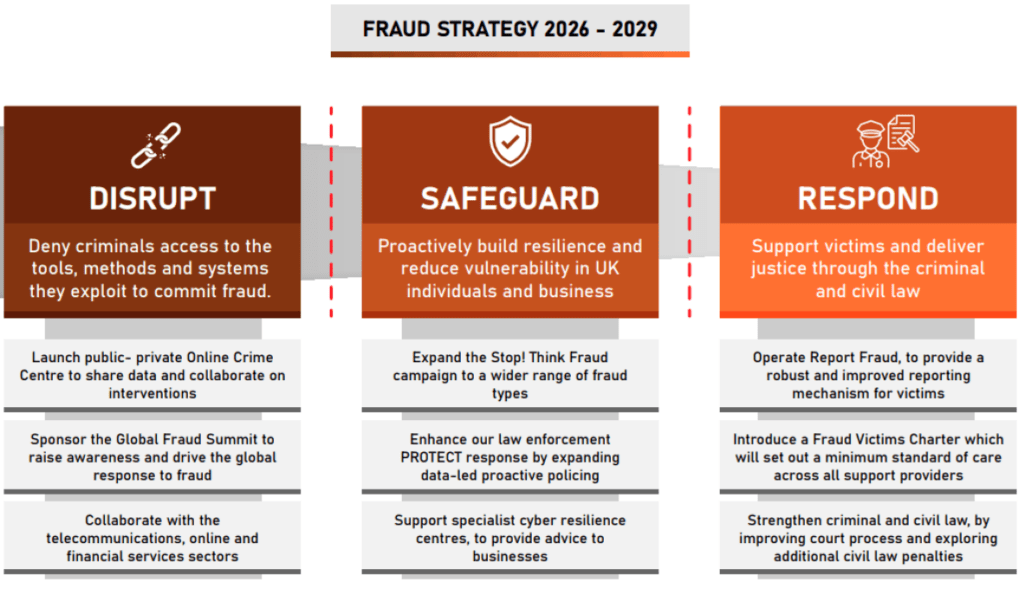
- Disrupt – key to disrupting fraud is the Government’s commitment of £31 million to launching an Online Crime Centre in April 2026. This initiative will unite Home Office, National Crime Agency, UK policing and UK intelligence with private sector partners from the financial, telecommunications, tech and cvber industries to accelerate the UK’s response by detecting emerging fraud patterns and shutting down accounts used by organised crime groups.
- Safeguard – the strategy recognises however that the pervasive nature of fraud means that a second line of defence is required to safeguard individuals and businesses from crime which is not disrupted at source. This pillar focuses on building resilience by educating the public on the fraud threat, including with a Stop! Think Fraud campaign, and by embedding financial, media and digital literacy in the school curriculum from an early age.
- Respond – finally, the strategy acknowledges the need for a strong response when fraud does occur, outlining how the government plans to improve support for victims, enhance investigative capabilities, improve international collaboration and deliver civil and criminal justice outcomes. Central to this is the new service Report Fraud – an efficient and user-friendly reporting mechanism which recognises the limitations of the previous Action Fraud service and provides better support to victims.
Delivery of the Fraud Strategy will be overseen by a revamped Joint Fraud Taskforce bringing together public and private sectors, a new Fraud Ministerial Accountability Group, and the transfer of fraud policing responsibility to the National Police Service alongside the National Crime Agency.
Comment
The pervasive, and perpetually evolving nature of the fraud threat, mean that prevention, detection, investigation and enforcement also need to adapt to stay ahead. This ambitious new multi-agency, public-private strategy recognises the challenges in keeping pace with a sophisticated and increasingly tech-enabled crime, but new initiatives being launched this year, together with inter-agency and international co-operation, will help to reduce the incidence and impact of this widespread scourge.
As reported last year, Gowling WLG has partnered with City of London Police to help victims of fraud recover their money. We look forward to supporting our government clients in delivering the Fraud Strategy given the expansion of their enforcement roles.

